When Does Healthy Eating Become Disordered Eating?
Maybe it started with cutting back on sugar, eating more vegetables, or following advice from a doctor or friend about what a "clean," balanced diet looks like. You thought you were being responsible and taking good care of yourself. But somewhere along the way, without a clear line to point to, healthy eating started to feel like something else. The rules and anxious thoughts kept piling up, and now you can't stop thinking about food, and you feel like you can't trust yourself around it, either. Disordered eating often begins this way, with "healthy eating" rules that slowly take over.
Most people who struggle with disordered eating weren't setting out to have an unhealthy relationship with food. In the beginning, it was just about eating healthy. I see this all the time in my work as a registered dietitian and certified intuitive eating counselor. I also know this territory personally. My own history of disordered eating is a big part of why I do this work, and it's part of how I recognize these patterns so clearly during sessions with clients. In my private practice, I work with clients who are in the same place: caught somewhere between "just being healthy" and something more rigid and obsessive, doubting if what they're experiencing even "counts" as disordered.
Jump to:
The Disordered Eating Spectrum
There's a common misconception that disordered eating is something you either have or you don't, and that it only counts if it looks a certain way. In reality, disordered eating exists on a spectrum, from occasional dieting all the way through diagnosable eating disorders like anorexia, bulimia, and binge eating disorder, with a lot of ground in between. Not everyone who goes on a diet develops an eating disorder, but many people who have an eating disorder started with dieting.
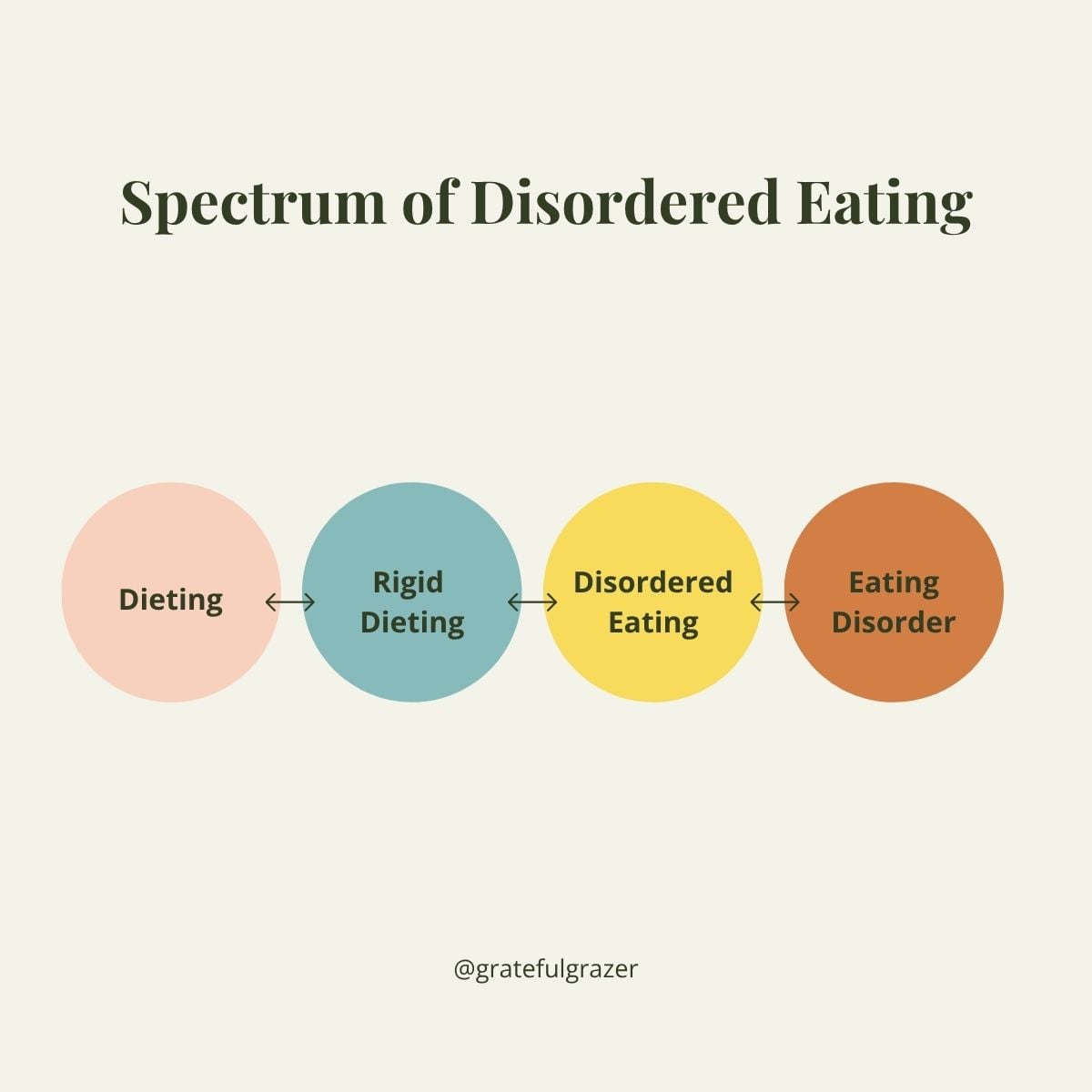
You can have disordered thoughts and behaviors around food without meeting criteria for a formal eating disorder diagnosis. You can be eating "well" by every external measure and still feel trapped by it. You don't have to be a certain size or have a formal diagnosis for this to be worth paying attention to.
Why "Healthy" Doesn't Always Mean Healthy
I'm a dietitian, so of course, I believe nutrition is important. What you eat impacts your energy, mood, and long-term health, and it's reasonable to want to eat in a way that supports your body.
But I would argue that your relationship with food matters even more than the nutrients you take in. Two people can eat the same exact way, follow the same exact guidance, and end up in very different places. For one person, eating more vegetables or cutting back on sugar is just one small part of a full life. For another, that same starting point slowly takes over and becomes rigid, anxiety-provoking, and all-consuming.
This shows up in a couple of different ways. For some people, the pull is toward a smaller body. Food rules become a tool for getting there, whether or not that goal is said out loud, and even though smaller doesn't actually mean healthier. For others, body size isn't really the driver at all. The pull is toward eating "correctly" or as "cleanly" as possible, and the rules exist to chase that feeling of doing it right. Both versions can look disciplined on the outside but actually feel pretty disruptive on the inside.
That's why "healthy eating" isn't a reliable signal on its own. What matters more is the intention behind it: whether there's room for flexibility or whether breaking a food rule brings on intense guilt or a need to compensate. Whether food feels like one part of your life or like something you spend way too much time and energy thinking about.
Orthorexia: When Healthy Eating Becomes an Obsession
One of the clearest and most commonly missed examples of this is orthorexia: an intense preoccupation with healthy eating or eating in a way that's perceived as pure, clean, or correct.
It might look like cutting out entire food groups, refusing to eat anything you can't verify the origin or ingredients of, or feeling real distress when a meal doesn't meet your standards. You might spend a disproportionate amount of time thinking about, planning, or researching food. Your friends and family might even praise it, since on the surface, it just looks like the disciplined commitment to health our culture values so highly.
Save This for Later
Free. Unsubscribe anytime.
It isn't necessarily the food choices themselves that determine whether you're struggling with orthorexia. The tell is the rigidity and emotional weight food rules carry. When eating "unhealthy foods" brings on guilt or anxiety instead of just being a normal part of life, that's a sign that your pursuit of health could actually be harming your well-being.
When You Feel Out of Control Around Food
Orthorexia isn't the only way this plays out. The misguided belief that eating "correctly" will lead to a smaller, healthier body often gets people stuck in disordered eating patterns like the binge-restrict cycle. A day of careful, rule-bound eating that ends with a binge, or feeling like you just can't stop eating, doesn't mean you lack discipline or willpower. It's often a direct response to the "healthy eating" rules you worked so hard to follow earlier in the day.
When you restrict food, even with the well-meaning intention to be healthy, your body feels like it's experiencing a famine. It responds by ramping up hunger signals and making food, especially the foods you've been avoiding, harder and harder to stop thinking about. This isn't just theory. The landmark Minnesota Starvation Experiment found that food restriction triggers intense preoccupation with food and eventual overeating once restriction lifts. So by the end of the day, or after days or weeks of restrictive "healthy eating," the pressure can build to the point where eating past fullness is almost inevitable. Your body isn't failing when this happens; it's acting exactly the way it's meant to when it doesn't get enough nourishment.
Going back to restricting the next day may feel like damage control, a way to undo what just happened, but it usually just resets the whole binge-restrict cycle again. If you notice that trying to eat healthy leads to moments where you feel out of control around food, know it's a predictable pattern that restriction creates, not a sign that something is wrong with you personally. It's also one of the clearest signs that "healthy eating" has crossed into disordered eating territory.
Disordered Eating Signs: Questions to Ask Yourself
If you've read this far and it's resonating, here are a few questions that can help you determine where you fall on the spectrum of disordered eating. These questions aren't meant to function as a diagnostic test, but they can be a useful starting point for self-reflection:
- How much of your day do you spend thinking about food or your body? Is it more than you want?
- Do you ever have moments where you feel out of control with your eating?
- Have you skipped meals or social plans involving food to stay in control of what or how you eat?
- Has anyone who cares about you expressed concern about your eating, exercise, or how you talk about food or your body?
- When you eat something outside your usual pattern, do you feel guilt, anxiety, or an urge to compensate (through restriction, exercise, or purging) afterward?
- Does your sense of discipline or self-worth feel tied to how "well" you ate that day?
If you answered "yes" to any of these questions, getting more intentional support around your relationship with food could be worth exploring.
Disordered Eating Support: What to Do Next
Naming a pattern like disordered eating is usually the first real step toward changing it. So what actually helps from here?
For some people, more consistent eating and more self-compassion, giving yourself real permission around food instead of more rules, is enough to start loosening the grip those patterns have. If that's you, my free Food Peace email series is a good next stop.
For others, especially if this has been going on for a while, or self-directed strategies haven't been enough on their own, working with someone trained specifically in disordered eating makes a real difference. You don't have to wait until things get worse to reach out for support. There isn't a certain weight or body size that makes you more deserving of care. You don't need a formal diagnosis or to have hit some imagined rock bottom first.
Working one-on-one with a weight-inclusive dietitian trained in eating disorders can help you understand what's actually driving these patterns and help you build something more sustainable and trustworthy than the rules ever were. If that sounds like something that would be supportive for you, I'd love to talk. You can learn more about my virtual nutrition counseling practice or send me a message to get started.
This post is educational and isn't a substitute for individual care. If you're struggling with your relationship with food or your body, please know that support is available. ANAD's free helpline (1-888-375-7767) offers support, answers questions about recovery, and can help connect you with treatment referrals.