How to Stop Obsessing Over Food
You're sitting at your desk trying to focus, but your mind keeps drifting to what you're going to eat for lunch. You finish dinner and immediately start thinking about dessert...and then feel guilty for thinking about it. You plan your meals carefully, eat what you're supposed to," and yet food somehow takes up most of your mental real estate for most of the day. If you're wondering how to stop obsessing over food, I want to start by telling you something that most advice on this topic gets wrong:
Food obsession is rarely a willpower problem. It's almost always a restriction problem.
I'm Stephanie, a registered dietitian and certified intuitive eating counselor. I work with people who are exhausted by how much mental space food takes up, and I've seen this pattern enough to say with confidence: the people who think about food constantly are usually the ones trying the hardest to control what they eat. The solution isn't more discipline. It's understanding what's actually driving the obsession and doing something different.
Jump to:
- Why You Can't Stop Thinking About Food
- How Restriction Affects Food Obsession
- The Restriction-Obsession Cycle Exlpained
- When "Healthy Eating" Makes Food Obsession Worse
- Ready to stop making food so complicated?
- What Actually Helps (And What Doesn't)
- How Long Does it Take to Stop Obsessing Over Food?
- When Food Obsession Needs Professional Support
- Is food taking up more mental space than you'd like?
- FAQ: Food Obsession
- What Comes Next
Why You Can't Stop Thinking About Food
Before we talk about what helps, it's worth understanding why food obsession (sometimes also called "food noise") happens in the first place. Because most people assume it means something is wrong with them.
For some people, intrusive food thoughts have a neurological or biological component, including certain eating disorder presentations, OCD, or other conditions where professional support from a therapist or treatment team is an important part of the picture. If that resonates with your experience, please don't let this post be your only resource.
It's also worth naming something that doesn't come up often enough in conversations about food preoccupation: food insecurity. If you're experiencing genuine uncertainty about whether you'll have reliable access to enough food, due to financial constraints, housing instability, or other circumstances, the food reoccupation you're experiencing is a direct, rational response to real scarcity. It's not a restriction mindset problem, and the solution is not psychological. If food insecurity is part of your experience, resources like SNAP and local food banks may be more immediately useful than anything else in this post. You deserve support that meets you where you actually are.
For many others, constant food preoccupation is a normal, predictable response to restriction and a strained relationship with food. These people don't lack willpower, they're not addicted to food, and they're not missing self-discipline that other people seem to have.
Understanding which is driving your experience, or whether it's some combination of both, is often the first useful step.
How Restriction Affects Food Obsession
Your brain is designed to become preoccupied with things you need but can't access freely. This is illustrated most starkly by the Minnesota Starvation Experiment, a landmark 1944 study in which healthy male volunteers were placed on severe caloric restriction. (Notably, the calorie targets were similar to many popular food tracking apps today.) The men became obsessed with food. They dreamed about it, talked about it constantly, and lost the ability to concentrate on much else. When the restriction ended, the obsession lifted.
You don't have to be on a starvation diet for this mechanism to activate. Rigid restriction (skipping meals, labeling foods as off-limits, eating less than your body needs, or even the mental restriction of telling yourself certain foods are "bad") can trigger the same preoccupation. The key isn't the specific behavior, but the psychological weight attached to it: when eating correctly feels high-stakes and effortful, your brain responds to food as if it's scarce.
This means that if you are thinking about food constantly, your brain may be sending you an important signal: you are not eating enough, not eating freely enough, or both.
The Restriction-Obsession Cycle Exlpained
Here's what the cycle typically looks like, and why it's so hard to break without understanding it.
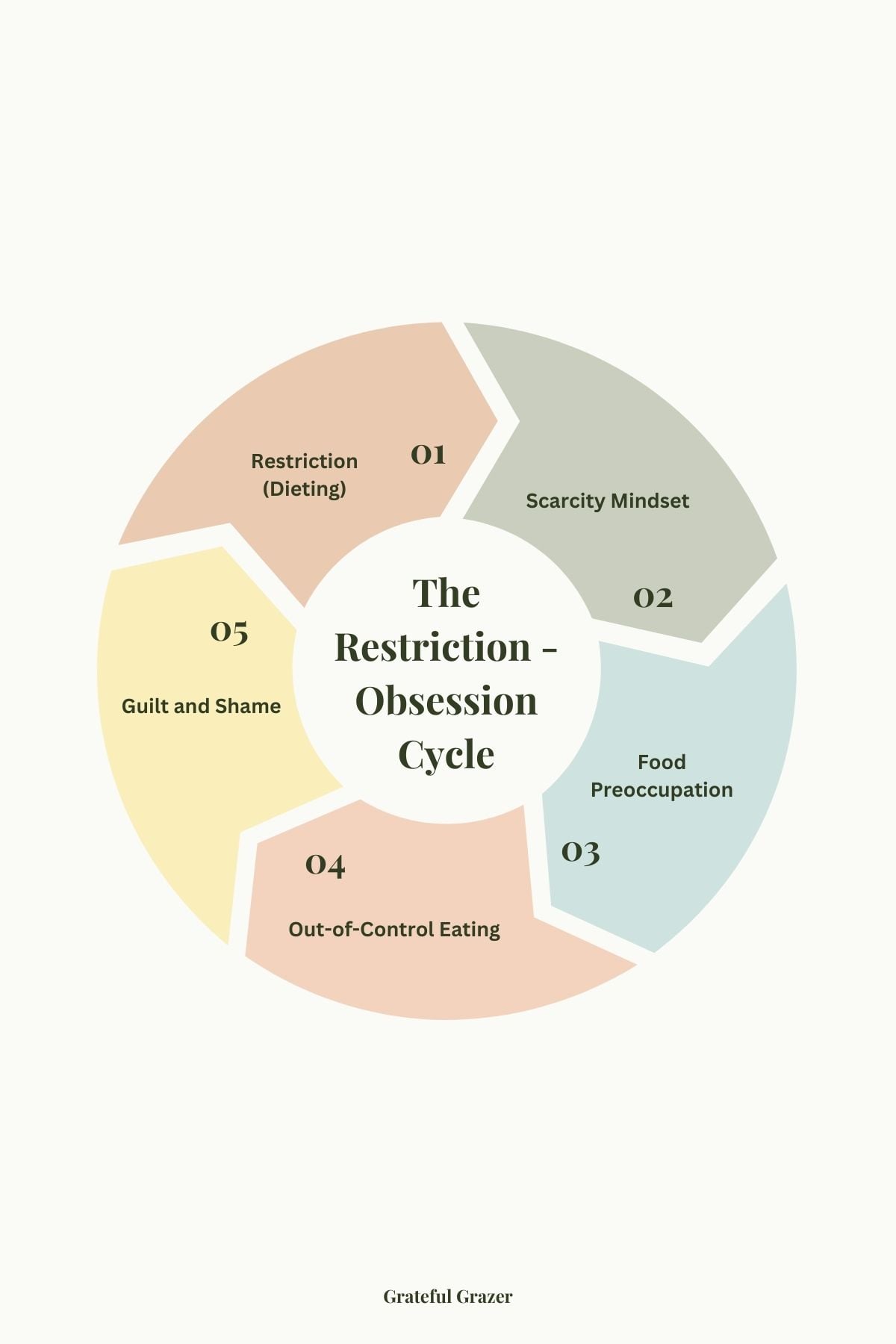
Step 1: Restriction begins
You start a new day of eating. Maybe a wellness plan, an elimination protocol, a plant-based approach, or just trying to "eat healthier." Some foods are limited or avoided. Portions are controlled. Certain times of day are designated for eating.
Step 2: Food feels scarce
Because some foods are now off-limits or scarce, your brain elevates them in importance. They become more appealing, more prominent in your thoughts. You find yourself thinking about them more than you ever did before you restricted them.
Step 3: Mental preoccupation intensifies
Food takes up increasing bandwidth. You think about what you've already eaten, what you're allowed to eat next, whether you've stayed "on track," and what you'll do if you slip. Planning, calculating, negotiating with yourself. It's exhausting.
Step 4: Out-of-control eating
At some point, the mental load becomes unbearable, or hunger becomes overwhelming, or you're in a social situation where the rules are hard to maintain. You eat the thing you've been avoiding, often quickly and in large amounts, with a feeling of being out of control.
Step 5: Guilt and shame
Intense feelings of guilt and shame follow. You tell yourself you'll do better tomorrow. And the cycle continues.
If this sounds familiar, you're not broken, and you're not alone. You're caught in a cycle that is physiologically predictable and extremely common, especially among people who genuinely care about their health and are trying to do the right thing.
The cruel irony is that the harder you try to control food, the more food controls you.
When "Healthy Eating" Makes Food Obsession Worse
This is an important part that's often overlooked. Food obsession isn't just a problem for people on crash diets or strict calorie restriction. It's also extremely common among people who are eating in ways that look and feel "healthy" from the outside. It can come up for people who:
- Eat mostly plants and whole foods, carefully and intentionally
- Follow a vegetarian, vegan, or plant-based approach for health
- Track macros or follow a structured meal plan
- Do cleanses, resets, or elimination protocols periodically
- Simply try very hard to "eat well" every day
The restriction driving food obsession in these ways isn't always caloric. Sometimes it's categorical. Certain foods are mentally off-limits not because of a formal diet, but because of internal beliefs about what's "healthy," "clean," or aligned with your values. Sometimes it's behavioral: eating only at certain times, stopping before you're truly satisfied, or never allowing yourself the thing you actually wanted.
Save This for Later
Free. Unsubscribe anytime.
Your brain doesn't care whether the restriction is labeled a "diet" or a "lifestyle." If it experiences scarcity (physical or psychological), it will respond with preoccupation.
I see this regularly in people who come to me after "healthy plant-based eating" turned into an obsession. They wanted to nourish themselves with more vegetables, feel good in their bodies, and align their eating with their values. Instead they ended up with a mental food police that ran commentary on every meal, a growing list of foods that felt unsafe, and an exhausting amount of mental energy devoted to eating "correctly."
If this sounds like your experience, the answer is not to fully abandon eating plants or stop caring about what you eat. It's understanding why the obsession developed and to approach from a different place of care and pleasure instead of control and compliance. Read more about vegetarian intuitive eating.
a Free 5-Day Email Series
Ready to stop making food so complicated?
Five days. One email a day. A gentler, more grounded way to think about food, delivered straight to your inbox by a non-diet dietitian.
Free. Unsubscribe anytime.
What Actually Helps (And What Doesn't)
Let's be honest about both, because a lot of common advice can make food obsession worse, not better.
What doesn't help (even though it seems like it should)
- Rigid meal plans and rule-based structure. Rigid meal plans feel like a solution because they promise to eliminate the uncertainty that food obsession feeds on. But they can actually intensify mental preoccupation because now you have a set of rules to follow, monitor, and inevitably break.
- Keeping "trigger foods" out of the house. If you don't have it, you can't eat it. Except that scarcity intensifies desire, and the foods you restrict most urgently are the ones your brain devotes the most space to. Instead, I work closely with clients to gradually and mindfully reintroduce "trigger foods" over time.
- Waiting until you're "really hungry" to eat. Delayed eating reinforces the pattern of ignoring hunger signals, which is part of what created the disconnection in the first place. It often leads to the intense, urgent hunger that makes eating feel out of control. (Download my free Hunger Scale Guide for more on this.)
- Trying to distract yourself from food thoughts. Distraction can be a short-term coping tool, but it's not a long-term solution.
- Tracking what you eat more carefully. Tracking often increases food preoccupation. The act of constant monitoring keeps food at the forefront of your attention. Read more about food tracking.
What Actually Helps
- Eat consistently and eat enough. This is the most unglamorous and most important change you can make. Regular, adequately sized meals throughout the day, including foods you genuinely enjoy, not just foods you feel you should eat, reduce the biological drive behind food preoccupation. When you follow a loose and flexible meal structure, your body knows food is reliably available, and the urgency and preoccupation begin to quiet. Consistent nourishment is the foundation everything else is built on. Read more about building satisfying plant-forward meals.
- Work toward unconditional permission to eat. Mental restriction (the inner voice that categorizes foods as good or bad, safe or unsafe, allowed or forbidden) maintains food obsession even when you're physically eating enough. The path through this is not "eat whatever you want, whenever you want, with no awareness." It's gradually dismantling the moral framework around food, so that no category of food holds disproportionate power over you. This is one of the central principles of intuitive eating, and it's often the most challenging part. Because for many people, food rules feel more like self-care than what they actually are: sneaky restriction. Learn more about unconditional permission to eat.
- Reconnect with satisfaction, not just fullness. There's a meaningful difference between being full and feeling satisfied. You can eat a large, nutritious, carefully planned meal and still feel a low-grade, nagging desire for something else. Satisfaction involves pleasure, not just volume. When meals are chosen based on what will "keep you on track" instead of what genuinely sounds good, satisfaction is often missing, and food thoughts persist even after eating. Practicing asking yourself what actually sounds good, and honoring that answer when possible, is part of quieting food obsession. Browse my collection of 60+ satisfying plant-forward dinner recipes for inspiration.
- Get curious about what else might need attention. Sometimes food thoughts are standing in for something else: stress, boredom, loneliness, anxiety, or the need for pleasure or comfort in a life that isn't offering much of it elsewhere. This doesn't mean there's something wrong with you or that you have an "emotional eating problem." It's human. Food is reliably pleasurable and accessible, so the brain turns toward it when other needs go unmet. Bringing curiosity to this without judgment can be genuinely illuminating. Not "I need to stop using food as a coping mechanism," but "what am I actually needing right now, and is there a way to address that directly?" Read more about emotional eating.
How Long Does it Take to Stop Obsessing Over Food?
I want to answer this question honestly instead of offering false reassurance, because there's no universal timeline.
For some people, simply eating more consistently and giving themselves permission around previously restricted foods produces a noticeable reduction in food preoccupation within a few weeks. For others, particularly people with a long history of chronic dieting, disordered eating, or a very rigid relationship with food, the process takes longer and benefits from professional support.
What I can tell you is the pattern does shift. People who have thought about food every waking hour for years can genuinely reach a place where food becomes a smaller, more ordinary presence in their mental life. Something they think about when they're hungry or planning meals, not something that runs as constant background noise.
The path is rarely linear. There will be periods of progress and periods where the obsession feels as loud as ever. Often that happens alongside a stressor, a social pressure, or a return to old food rules. Use these periods as information and not evidence of failure.
When Food Obsession Needs Professional Support
Eating more consistently, working toward food permission, and reconnecting with satisfaction help a log of people make meaningful progress with food obsession on their own.
But sometimes that pattern is deep enough, or has been running long enough, that professional support makes the difference between continuing to struggle and actually feeling free. Consider reaching out to a non-diet dietitian or therapist if:
- Food thoughts are interfering with your ability to concenrate, work, maintain relationships, or enjoy your life
- You've been trying to address this on your own for a long time without significant change
- The obsession is accompanied by restriction, bingeing, purging, or other disordered eating behaviors
- You notice that "healthy eating" keeps making things worse
- You feel like you've tried everything and nothing has worked
If you've read all of the articles, tried all of the strategies, and still find yourself consumed by food thoughts, that's a sign that the work probably needs to happen in relationship with another person who can help you see what you can't from inside the pattern.
For people whose food obsession is accompanied by significant anxiety, intrusive thoughts in other areas of life, or other mental health symptoms, working with a therapist alongside a dietitian is often more effective than either alone.
This is exactly what I do in 1:1 nutrition counseling. Not meal plans or rules, but real, curious, compassionate work on what's underneath the obsession, so you can get to the other side of it.
The person I work with is often someone who genuinely cares about eating well, often eats mostly plants, and is exhausted by how loud the mental noise around food has gotten. If that's you, I'd love to have a conversation.
- Book a free discovery conversation - low-pressure, no obligation, just an honest conversation about where you're at.
- Not ready for that yet? Start with my free 5 Days to Food Peace email series - a gentle, no-rules introduction to making peace with food, one email at a time.
Is food taking up more mental space than you'd like?
If you've understood for a while that restriction is part of the problem, but knowing that hasn't actually made the thoughts quieter, that's not a failure. It's a sign this work is genuinely hard to do alone.
I work with people who are exhausted by how much mental energy food consumes and ready for that to actually change. Not through more rules, but through real, specific work on what's driving the pattern in your particular life.
If that sounds like where you are, I'd love to talk.
15 minutes, no pressure, no obligation.
FAQ: Food Obsession
Reducing food obsession starts with addressing its most common cause: restriction. eating consistently, giving yourself genuine permission to eat all foods, and choosing meals that are genuinely satisfying, not just nutritious, often quiets food preoccupation more reliably than distraction or willpower.
Food obsession is most commonly caused by restriction: physical undereating, mental food rules, or both. When the brain perceives food as scarce or off-limits, it responds by elevating food in your thoughts as a survival mechanism. The harder you try to control food, the more mental space it occupies.
Obsessive eating is usually driven by restriction, not a lack of willpower. The most effective path forward is eating more consistently, expanding food permission, and rebuilding trust with your body's hunger and fullness signals, often with professional support from a non-diet dietitian or therapist who specializes in disordered eating.
What Comes Next
If this post resonated, here are the most useful steps depending on where you are right now:
- Read next: What to Do When You Feel Out of Control Around Food
- Read next: Are You Really Giving Yourself Unconditional Permission to Eat?
- Read next: What Causes Emotional Eating?
- Read next: Can you Eat Plant-Forward Without Food Rules
- Free resource: 5 Days to Food Peace email series
- Work together: Learn about 1:1 nutrition counseling
5 Days to Food Peace: A free email series from a non-diet dietitian
Not ready to work together yet? Start here.
Every day for five days, I'll send you one honest, practical email about making peace with food. What that actually means, why it's harder than it sounds, and what starts to shift when you stop fighting your own hunger. It's free, short, and there's no catch.

Stephanie McKercher, MS, RDN Registered Dietitian & Certified Intuitive eating Counselor
I created Grateful Grazer because I believe eating more plants and making peace with food should go together, not feel like opposing forces. I write about both from from personal experience and years of clinical work, and I'm genuinely glad you found your way here.