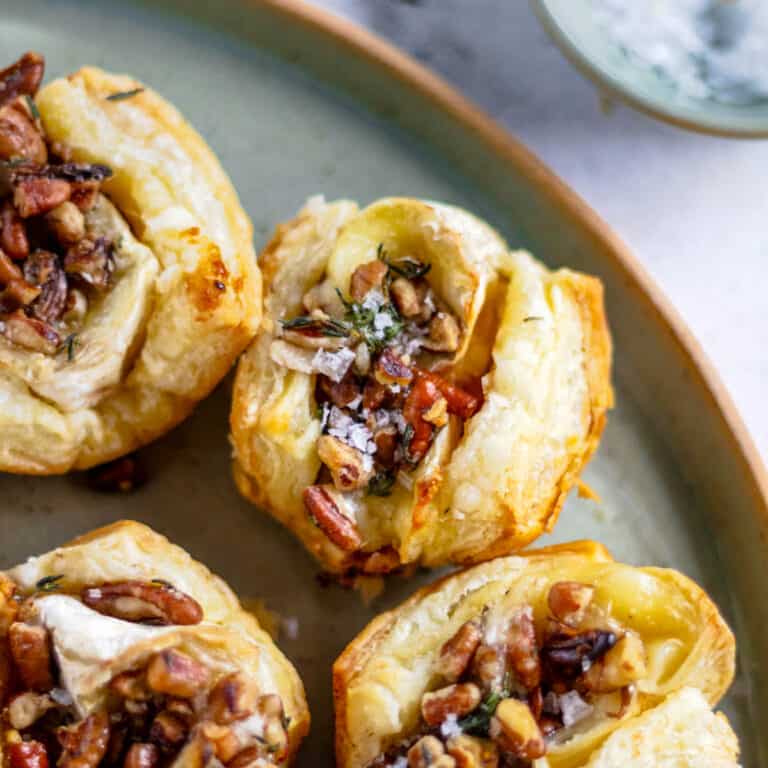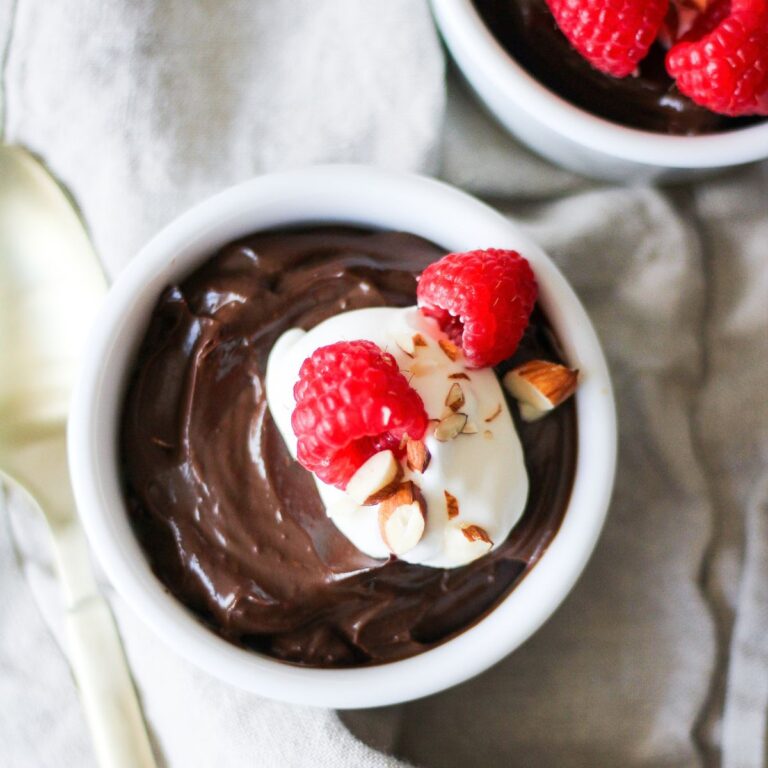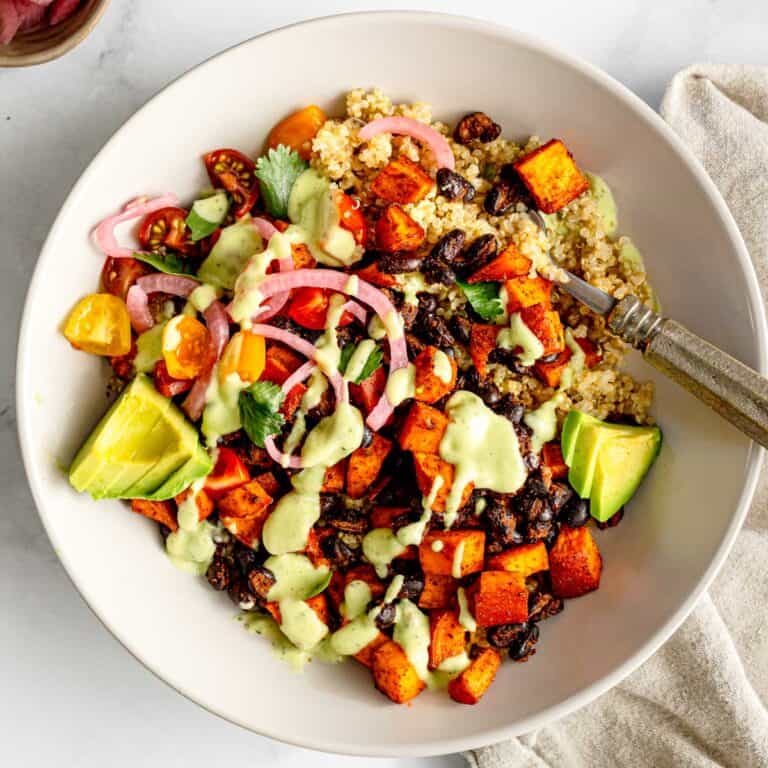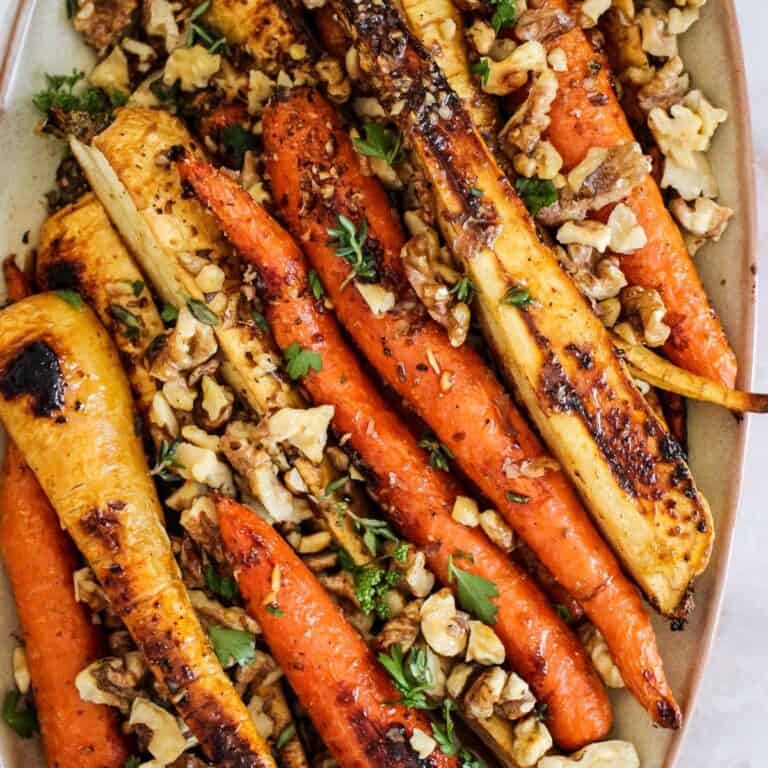
Vegetarian Intuitive Eating: A Non-Diet Dietitian's Guide
Maybe you've been eating vegetarian or plant-based for years. Or maybe you're drawn to eating more plants, but every time you try, it starts feeling like another set of rules...another diet dressed up in a kale smoothie. You're wondering: can vegetarian intuitive eating actually work? Can you eat mostly plants and make peace with food at the same time?
The short answer is yes, but it takes more nuance than most nutrition advice gives it credit for.
As a registered dietitian and certified intuitive eating counselor who eats a flexible, plant-forward diet myself, I've worked through this exact tension personally and professionally. In this post, I'll walk you through what vegetarian intuitive eating actually looks like in practice, how to tell if your plant-based approach is rooted in values or restriction, and what to do when the two get tangled up.
Jump to:
- What is Vegetarian Intuitive Eating?
- Can You Really Be Vegetarian and Practice Intuitive Eating?
- How Plant-Based Eating Can Become a Diet Without You Realizing It
- Values vs. Restriction: How to Tell the Difference
- Practical Tips for Plant-Based Intuitive Eating
- Ready to stop making food so complicated?
- Vegetarian Intuitive Eating in Recovery from Disordered Eating
- What Plant-Forward Intuitive Eating Actually Looks Like Day-to-Day
- Working with a Non-Diet Dietitian for Plant-Based Intuitive Eating Support
- Does eating plant-forward ever feel like another set of rules?
- FAQ: Vegetarian Intuitive Eating
What is Vegetarian Intuitive Eating?
Vegetarian intuitive eating is an approach that combines a plant-forward or vegetarian way of eating with the principles of intuitive eating, a non-diet framework developed by dietitians Evelyn Tribole and Elyse Resch that emphasizes body attunement, hunger and fullness cues, and making peace with food.
At its core, intuitive eating asks you to eat in a way that honors your body's signals, your satisfaction, and your values, without rigid food rules, moral judgments about food, or using eating as a way to control your body size.
Vegetarianism, at its best, is a values-based way of eating rooted in ethics, environmental care, cultural identity, or personal preference. When it comes from a grounded place, it fits naturally within an intuitive eating practice.
Then tension arises when vegetarianism or plant-based eating gets co-opted by diet culture. When "I eat plants because I care about animals" stealthily becomes "I eat plants because it feels like the healthiest, cleanest, most controlled way to eat." That shift canbe subtle, but it's common and worth paying attention to.
Can You Really Be Vegetarian and Practice Intuitive Eating?
Yes. With one important distinction. Intuitive eating is not about eating everything, all the time, with no preferences or values guiding you. That's a common misconception. Intuitive eating is about making food choices from a place of care instead of control. Eating from connection to your body, your values, and your lived experience, and not from fear, guilt, or the desire to shrink yourself.
Choosing not to eat meat because it conflicts with your ethics is different from avoiding meat because it feels "unclean" or because you're using vegetarianism as a framework to eat less. One is a value. Another is a rule.
The intuitive eating framework specifically addresses this: Principle 10, Gentle Nutrition, acknowledges that you can have food preferences and values while still practicing food freedom. Your vegetarian or plant-based approach can absolutely be one of those values, as long as it's flexible enough to nourish you fully and doesn't function as a disguised form of restriction.
How Plant-Based Eating Can Become a Diet Without You Realizing It
This is the part most plant-based nutrition content skips over entirely. And it's exactly why plant-based intuitive eating is more complicated than it sounds.
Diet culture is very good at wearing a plant-based costume.
"Clean eating" became plant-based eating. Juice cleanses became green smoothie protocols. "Eating whole foods" became avoiding anything processed. The language changed, but the underlying control (and the shame spiral when you "fell off') stayed exactly the same.
If you've ever:
- Gone plant-based or vegan and found yourself feeling anxious about food, not more peaceful
- Used vegetarianism as a way to justify eating less or avoiding entire food groups
- Felt moral superiority for eating plants or shame when you ate animal products
- Noticed that "eating healthy" always leads you toward more rules, not more freedom
- Starting eating mostly plants but ended up more obsessed with food than before
...then what you're experiencing is diet culture wearing a plant-forward mask. And it's incredibly common, especially for people with a history of chronic dieting who are drawn to plant-based eating because it feels like a healthier, more virtuous version of restriction.
This doesn't mean plant-based eating is bad. It means the way we've been taught to approach it could use a reframe.
Values vs. Restriction: How to Tell the Difference
Here's a framework I use with clients who are trying to untangle whether their vegetarian or plant-based eating is genuinely values-driven or functioning as a form of restriction.
Ask yourself:
- Did I become a vegetarian because of genuine ethical, environmental, or cultural values, or to control my body or how I ate?
- Do I feel flexible within my vegetarianism, or do I feel anxious or rigid when I encounter situations that don't fit my rules?
- If I ate an animal product, would I feel mild discomfort because of my values or overwhelming guilt and shame?
- If my plant-based approach nourishing me fully, or am I using it to justify eating less?
- Have I ever used vegetarianism to avoid social situations involving food, or to feel in control?
- If eating plants had no impact on my body size or "health," would I still choose it?
There's no perfect answer to these questions, and the line between values and restriction isn't always clear, but honest curiosity here is where healing starts.
A practical comparison:
| Vegetarian Intuitive Eating | Vegetarianism as Restriction |
|---|---|
| Rooted in ethics, environment, culture, or genuine preference | Used to eat less, lose weight, or feel "in control" |
| Feels flexible and nourishing | Feels rigid, anxiety-producing, or depleting |
| You can navigate social situations without significant distress | You avoid situations where your rules might be challenged |
| You feel satisfied and energized by your meals | You often feel deprived, hungry, or preoccupied with food |
| Choosing not to eat meat feels like an expression of care | Not eating meat feels like a requirement you can't break |
| You extend compassion to yourself on days you eat differently | You feel guilt, shame, or a need to "make up for it" |
Practical Tips for Plant-Based Intuitive Eating
If you're working on combining a vegetarian or plant-forward approach with intutiive eating, here are some ways to support that practice.
1. Center Satisfaction, Not Just Nutrition
Intuitive eating places genuine satisfaction at the center of your eating experience, not just nutrients or fullness, but the pleasure and enjoyment of eating. For vegetarian intuitive eating, this means asking: Is this meal actually satisfying to me? A salad that leaves you hungry and dissatisfied 45 minutes later isn't honoring your body, even if it's full of vegetables.
When building satisfying plant-forward meals, think about flavor, texture, and satiety together. If you need ideas, browse my collection of satisfying vegetarian dinner ideas here.
2. Make Sure You're Actually Eating Enough
One of the most common patterns I see in plant-based intuitive eating work is undereating that gets masked as "clean eating" or "eating light." Plant-based meals can be deeply nourishing and satisfying, but they can also be easy to undereat if you're loading up on vegetables without enough calorie-dense, protein-rich, or fat-containing foods to keep you genuinely full.
Key nutrients to keep in mind without obsessing over them: protein (beans, lentils, tofu, tempeh, edamame, dairy, eggs), iron, B12, zinc, and omega-3 fatty acids. This isn't about tracking or perfecting, it's about making sure your body has what it needs to feel good. See high-protein vegetarian recipes for inspiration.
Save This for Later
Free. Unsubscribe anytime.
Practice Flexibility in Social Situations
Rigid eating rules tend create anxiety and isolation, which runs counter to the spirit of both intuitive eating and a genuinely nourishing relationship with food. You get to define your own boundaries around vegetarianism, and you're allowed to make different choices in different contexts.
Maybe you eat vegetarian at home, but don't stress about chicken broth at a dinner party. Maybe you're fully plant-based 95% of the time and occasionally eat differently when traveling. Maybe you're somewhere in the middle. There's no one correct answer. What matters is that your approach is flexible enough to support your actual life.
4. Check in with Hunger and Fullness Cues
Are your hunger and fullness cues available to you within your vegetarian framework? Or are you eating in ways that override or ignore them? (Ex. eating only at scheduled times, always stopping before you're satisfied, or eating past fullness to "get enough protein.")
Reconnecting with hunger and fullness is a core of intuitive eating, and it works within a vegetarian framework when your meals are nourishing and satisfying enough to give you clear signals. Download my free Hunger Scale tool to help you reconnect with your body.
5. Let Go of the "Plant-Based" Identity as a Moral Status
Diet culture loves to assign moral virtue to eating patterns, and plant-based eating is one of its current favorites. "I eat plant-based" can become a source of identity, superiority, or shame, which is the opposite of food freedom.
You can care deeply about eating more plants and have absolutely no moral attachment to being a "plant-based person." In fact, releasing the identity rigidity often makes it easier to enjoy plants, because you're eating them from a place of genuine pleasure, not because your worth depends on it.
a Free 5-Day Email Series
Ready to stop making food so complicated?
Five days. One email a day. A gentler, more grounded way to think about food, delivered straight to your inbox by a non-diet dietitian.
Free. Unsubscribe anytime.
Vegetarian Intuitive Eating in Recovery from Disordered Eating
If you're recovering from disordered eating or chronic dieting, your relationship with vegetarianism or plant-based eating deserves extra care and honest reflection.
Research has found meaningful associations between plant-based eating patterns and disordered eating behaviors, not because eating plants is harmful, but because plant-based eating can function as a socially acceptable framework for restriction. A landmark 2012 study published in the Journal of the Academy of Nutrition and Dietetics found that women with an eating disorder history were significantly more likely to have been vegetarian than those without, and that most reported their vegetarianism was primarily motivated by weight control and had emerged after the eating disorder onset, not before (Bardone-Cone et al., 2012).
A more recent 2025 review published in Nutrients examined the overlap between orthorexia and plant-based diets specifically, describing what the authors call a potential "vicious cycle": disordered eating can lead someone toward plant-based frameworks as a vehicle for restriction, and that plant-based framework can in turn reinforce and deepen the restriction, making the cycle harder to interrupt (Szulc et al., 2025). Researchers note the direction isn't always clear. Sometimes orthorexic patterns emerge first, sometimes restrictive plant-based eating comes first, but once present together, each can feed the other.
It's also worth noting something that the same researchers point out: not every plant-based eater who avoids certain foods is disordered. Genuine ethical or values-based commitment to plant-based eating can look rigid from the outside without being pathological. The question isn't what someone is eating, it's whether anxiety, rigidity, and impairment are driving the choices.
Across the research, the most consistent finding is that motivation matters more than diet type. Plant-based eating rooted in genuine ethics, values, or culture is consistently associated with lower rates of disordered eating. Plant-based eating driven by weight control or health optimization is consistently associated with higher rates. A 2020 study in the International Journal of Eating Disorders (one of the largest of its kind, with nearly 10,000 college students) found that weight-motivated vegetarians showed significantly higher levels of restraint, body dissatisfaction, and global eating disorder psychopathology compared to both ethically-motivated vegetarians and non-vegetarians (Zickgraf et al., 2020). A separate study found this pattern was especially pronounced among semi-vegetarians (the flexitarian, mostly plant-based crowd) where their motivation was weight or health related (Sieke et al., 2021).
This doesn't mean you need to give up eating vegetarian in recovery. But it does mean it's worth asking: Is my plant-based eating supporting my healing, or is it functioning as restriction wearing a different name?
Some questions to reflect on:
- Did I become vegetarian during or because of my eating disorder, even if I didn't recongize it at the time?
- Am I using "I don't eat meat" as a way to limit my food choices without having to say I'm dieting?
- Does my plant-based approach expand my eating and my sense of freedom or does it limit it?
- Would I feel comfortable being flexible (eating an animal product) without significant guilt or distress?
There are no right or wrong answers here. Recovery looks different for everyone, and some people maintain a genuine values-based vegetarian practice throughout their healing. But this conversation is worth having, ideally with a non-diet dietitian who understands both intuitive eating and plant-based nutrition. Learn more about working together here.
What Plant-Forward Intuitive Eating Actually Looks Like Day-to-Day
I want to be honest: I don't eat by a strict vegetarian label. I eat a flexible, plant-forward diet, meaning plants are at the center of most of my meals, but I don't follow rigid rules about it, and I don't assign moral value to any particular food choice.
For me, this is what plant-based intuitive eating actually looks like in practice:
- Most of my meals are built around vegetables, beans, lentils, grains, eggs, and dairy. Not because I'm following a rule, but because I genuinely enjoy them and they make me feel good.
- I don't stress about chicken broth, a piece of salmon, or eating a non-vegetarian dish at a restaurant or dinner party.
- I eat this way because it feels aligned with my values around sustainability and my own body's preferences, not because I believe it's the "healthiest" or "cleanest" way to eat.
- On days when I want something different, I eat it, and I don't spend energy on guilt or compensating.
That flexibility is the whole point. You can deeply love plant-forward eating and hold it loosely at the same time. In fact, holding it loosely is often what makes it sustainable and pleasurable long-term.
Working with a Non-Diet Dietitian for Plant-Based Intuitive Eating Support
If you're finding that plant-based eating and food freedom feel like they're consistently pulling against each other, or if you're noticing patterns of restriction, obsession, or anxiety around your "healthy eating," that's worth exploring with support.
I work with people who want to eat more plants without it turning into another diet. People who are exhausted by making every food decision a moral one. People who want to nourish themselves with plant-forward meals and actually enjoy the experience.
This work looks different from traditional nutrition counseling. We don't count, track, or prescribe. We get curious about your patterns, reconnect with you own body's signals, and help you build a relationship with food that's steady, satisfying, and actually sustainable.
It this resonates, here are a couple of ways to take the next step:
- Start my free 5-Day Food Peace email series: a gentle introduction to intuitive eating delivered to your inbox.
- Book a free discovery call consultation: a low-pressure chat about where you're at and whether working together might be a good fit.
Does eating plant-forward ever feel like another set of rules?
If you've found yourself eating carefully, choosing all the "right" things, and still feeling anxious, obsessed, or out of control around food, that pattern is genuinely hard to untangle alone.
I work with people who love eating plants and want to keep doing it, but need it to feel free rather than obsessive. If that's where you are, I'd love to talk.
15 minutes, no pressure, no obligation.
FAQ: Vegetarian Intuitive Eating
Yes. Vegetarian intuitive eating is absolutely possible when your plant-based choices are grounded in genuine values, like ethics, culture, or environmental care, instead of restriction or the desire to control your body. The key is making sure your vegetarian approach is flexible enough to nourish you fully and isn't functioning as a disguised form of dieting.
Not if it's values-based. Intuitive eating distinguishes between food rules driven by fear, guilt, or body control, and food choices driven by genuine values, preferences, or cultural identity. Choosing not to eat meat because it conflicts with your ethics is different from avoiding meat as a form of restriction. The question to ask yourself: does this choice feel like care or control?
Plant-based eating can sometimes overlap with or mask disordered eating patterns, particularly orthorexia, a preoccupation with eating "correctly" that causes significant anxiety and impairment. Research has found higher rates of orthorexia-adjacent behaviors among people following vegan and vegetarian diets, particularly when health-motivated. This doesn't mean plant-based eating causes eating causes eating disorders, but it does mean the pattern is worth paying attention to, especially if "eating healthy" consistently leaves you more anxious, not less.
A plant-forward intuitive eating approach centers plants (vegetables, legumes, grains, nuts, and seeds) without rigid rules about being perfectly vegan or vegetarian. It's flexible, pleasure-centered, and rooted in care rather than control. Most meals might be plant-centered, while still leaving room for animal products, flexibility in social situations, and eating based on what genuinely sounds good and feels satisfying.
Absolutely. A non-diet, weight-inclusive dietitian can support you in building a plant-forward eating practice that honors both your values and your body, without pressuring you to eat animal products or abandon your vegetarian approach. The goal is helping you eat in a way that feels both aligned and free.
5 Days to Food Peace: A free email series from a non-diet dietitian
Not ready to work together yet? Start here.
Every day for five days, I'll send you one honest, practical email about making peace with food. What that actually means, why it's harder than it sounds, and what starts to shift when you stop fighting your own hunger. It's free, short, and there's no catch.
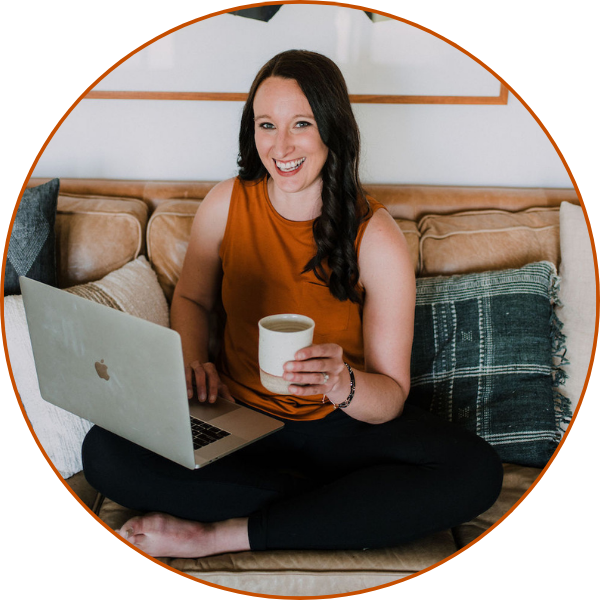
Stephanie McKercher, MS, RDN Registered Dietitian & Certified Intuitive eating Counselor
I created Grateful Grazer because I believe eating more plants and making peace with food should go together, not feel like opposing forces. I write about both from from personal experience and years of clinical work, and I'm genuinely glad you found your way here.